
How Long Can You Go Without
Paying Property Taxes in Indiana?
If you’ve fallen behind on property taxes, the key question is:
How much time do you actually have?
In Indiana, the process moves in stages from a missed payment to a tax sale if nothing is done.
The timing can vary, but the path is predictable.
This page shows you how long each stage typically lasts and where you may be right now.

The Short Answer - How Much Time
You Typically Have
You don’t lose your property right after missing a payment.
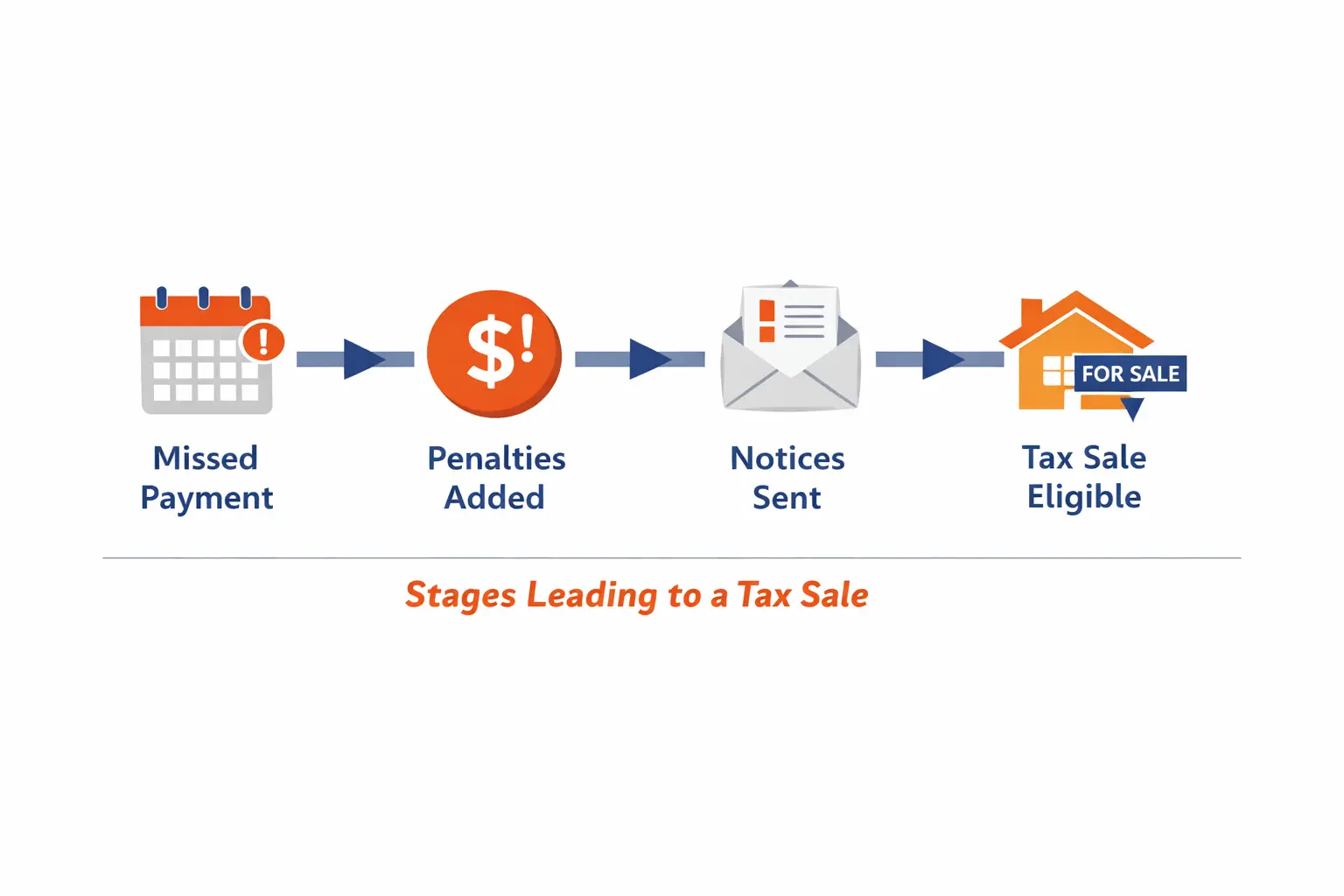
In Indiana, the process from missed payment to tax sale typically takes months, sometimes longer, depending on the situation.
It follows stages:
- missed payment
- penalties added
- notices sent
- tax sale eligibility
You usually have time BUT the process continues if nothing is done.
The Property Tax Timeline in Indiana
Property taxes in Indiana follow a set path once a payment is missed. It doesn’t jump from late to loss of property, it moves through stages over time.
At a high level, the timeline looks like this:
- Missed Payment
Payment becomes past due. - Delinquency and Penalties
Taxes are marked delinquent and the balance increases. - Notices and Collection
The county sends notices over time. - Eligibility for Tax Sale
The property can be scheduled for a tax sale. - Tax Sale and Redemption Period
The debt is sold, but you still have time to pay and keep the property.
Tax Sale and Redemption Period
The unpaid taxes are sold, but there is still a set period where you can pay what’s owed and keep the property.
The important thing to understand is that this is a progression, not a single event.
Each stage builds on the one before it, and where you are in that timeline determines how much time and flexibility you still have.
This is the general timeline. For a full step-by-step explanation of what happens at each stage,
click here to view the full breakdown of the property tax process.
Where You Might Be in the Timeline
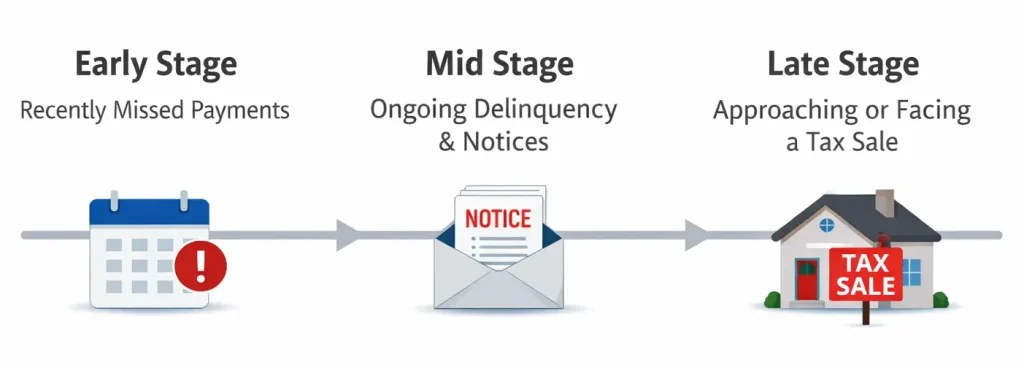
Early Stage (Recently Missed Payments)
Missed a payment. Balance is past due. Most flexibility remains.
Mid Stage (Ongoing Delinquency and Notices)
Balance has grown. Notices are being received.
Late Stage (Approaching or Facing a Tax Sale)
Tax sale may be scheduled. Timing matters.
If you’re not sure which stage you’re in, a simple way to think about it is:
- Just missed a payment → early
- Receiving notices and balance growing → mid
- Hearing about a tax sale → late
Understanding where you are is what turns this from a question into a decision.
What Aspects Affects How Long You Have
Not every situation follows the exact same timeline.
While the overall process is structured, how quickly it moves can vary based on a few key factors:
Time Unpaid
The longer the balance has been outstanding, the further along you are in the process. Someone who just missed a payment is in a very different position from someone who has been behind for multiple cycles.
County Process
Each county in Indiana follows the same general system, but timing can vary slightly depending on how quickly notices are processed and when tax sales are scheduled.
Amount Owed
A larger balance can make it harder to catch up, which can affect how quickly the situation progresses.
Notices or Legal Steps
If you've received formal notices or communication about a tax sale, you’re further along in the timeline than someone who has only recently missed a payment.
The key is this:
There is a general timeline, but your position within it depends on your situation.
Understanding these factors helps you judge how much time you likely have left, not just how the process works in theory.
What Waiting Actually Changes
When property taxes go unpaid, the situation doesn’t stay the same, it continues to move forward.
Balance Increases
Penalties and interest add up.
Timeline Progresses
The process continues even if you do nothing.
Options Reduce
Fewer ways to resolve it over time.

Waiting doesn’t cause everything to happen at once, but it does change the outcome over time.
The earlier you understand where you stand, the more choices you typically have available.
To learn more about what happens when you don't pay property taxes, click here.
Signs It’s Becoming More Urgent
As the process moves forward, there are clear signs that things are becoming more time-sensitive.
Receiving Multiple Notices
It usually means the situation has moved beyond the early stage and is continuing to progress.
More Than One Missed Cycle
If multiple payments have been missed and the balance has been carried over, you’re further along in the timeline.
Stronger Language in Notices
As things progress, notices may include stronger language, deadlines, or references to next steps.
Tax Sale Mentioned
If a tax sale is mentioned, you are in the later stage of the process, where timing becomes more important.
These signs don’t mean it’s too late.
But they do mean that it’s worth paying closer attention to where you are in the timeline and what you want to do next.
What You Can Do Based on Where You Are
What you can do depends on where you are in the timeline. The earlier you are, the more flexibility you typically have.
Early Stage
The easiest and most direct option is to bring the balance up to date.

Mid Stage
Understand your balance due and timelines. Contact the county.

Late Stage
Deciding how you want to handle the situation before it moves further.
If You Want to Stop the Process Before a Tax Sale
Selling is one way to stop the process.
Why Some Choose This
It allows you to control the outcome instead of waiting.
How It Stops the Process
Taxes are paid during closing.
When It Becomes Relevant
When catching up isn’t realistic or time is limited.
It’s an option, not the only one, but it resolves the situation before it escalates.
You’re Not the Only One Dealing With This
If you decide to explore selling as an option, the process is usually more straightforward than most people expect.
How a Simple, Direct Sale Works
It starts with a quick conversation about the property and your situation. From there, the property is reviewed, and an offer is calculated based on its condition and the current market.
No repairs, no cleaning, and no multiple showings.

What Happens After You Reach Out
Once you make contact:
- the property is reviewed (in person or virtually)
- you receive a clear, no-obligation offer
- you decide whether or not it makes sense for you
There’s no pressure to move forward.
How Timing and Closing Can Be Flexible
If you choose to sell, the timeline can be adjusted to fit your situation and timeline.
This is about understanding your options, not committing to anything.
Talk To Us About Your Situation or Get Your Cash Offer Today
Get Your Free Offer TODAY!
Fill In This Form To Get Your No-Obligation All Cash Offer Started!